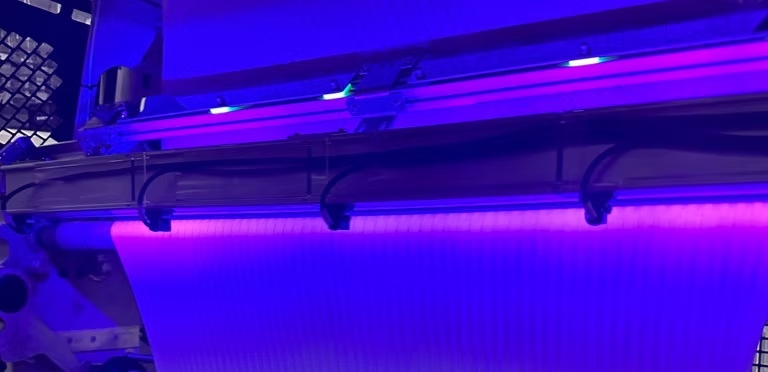
How we trained Profna Vision on twenty million loops
Inside the dataset, the edge runtime and what it takes to detect a defect in 40 ms.
Twenty million loops is not a marketing number — it is the size of the labelled image set we currently use to train Profna Vision. About 60 percent of it comes from controlled rigs in our Lithuania lab; the rest is collected, with permission, from real production lines across Lithuania, Germany and Portugal.
The hardest part is not the network architecture — open-source backbones get you to a workable baseline in a weekend. The hard part is the long tail: the defects that show up once a week on a single yarn count under one specific lighting condition. Those rare events are the ones operators care most about, and they are the ones a generic model will silently miss.
Our pipeline therefore optimises for tail recall, not headline accuracy. Every customer rollout starts with a one-week calibration phase where Vision learns the look of that specific mill's yarns and lights. After calibration, the edge model is small enough to run inference in 28 to 40 ms on a fanless industrial PC sitting next to the machine — no cloud round-trips, no missed milliseconds.
Talk to us
Curious how this would land in your mill?
We are happy to walk through your machines, your data, and where Profna would fit.
Book a conversation